Your Metabolism Has a Timeline: Age-Stratified Anti-Aging Strategies That Actually Work
The moment you hit your late twenties, something shifts. That pizza you could demolish at 2 AM without consequences? Suddenly it sticks around as belly fat. The all-nighters that left you merely groggy? Now they take three days to recover from. This isn't just lifestyle catching up—it's your metabolism beginning its decades-long transformation.
What most people don't realize is that metabolic aging doesn't happen gradually. It occurs in distinct phases, each with its own biochemical signature and intervention opportunities. Understanding these phases transforms anti-aging from vague wellness advice into targeted, time-sensitive action.
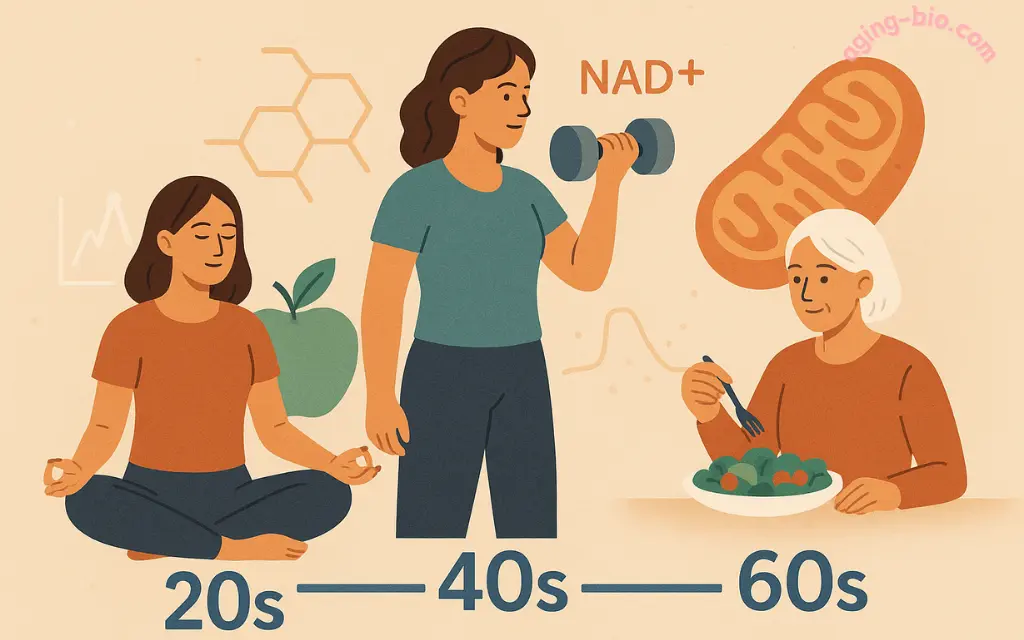
The Metabolic Timeline Nobody Told You About
Your metabolism isn't just slowing down—it's fundamentally rewiring itself. Research from mitochondrial biology reveals that cellular energy production follows predictable patterns across the lifespan, with critical inflection points around ages 30, 45, and 65. These aren't arbitrary numbers; they represent when specific metabolic pathways begin their decline.
The fascinating part? Each age window responds to different interventions. The strategies that work brilliantly at 25 can be counterproductive at 55. Your cells literally speak different biochemical languages as you age.
Phase One: Your 20s—The Foundation Window (Ages 20-35)
What's Actually Happening
During your twenties, you're operating on metabolic credit. Your mitochondria—the cellular power plants—are running at peak efficiency, producing ATP with minimal waste. NAD+ levels are naturally high, supporting robust DNA repair and cellular maintenance. But beneath this apparent vitality, the first cracks are forming.
Research shows that mitochondrial complex activity begins declining subtly around age 25. The PGC-1alpha pathway, which controls mitochondrial biogenesis, starts showing reduced expression. You're still building mitochondria efficiently, but the rate of new formation is beginning to lag behind cellular needs.
The hidden danger: This is when metabolic flexibility—the ability to switch between fuel sources—starts narrowing. Young adults can seamlessly transition between glucose and fatty acid oxidation, but this adaptability begins its slow constriction.
The 20s Metabolic Priority: Build Resilience
Your twenties represent the last optimal window for establishing mitochondrial abundance. Think of it as building a retirement fund for your cells. The more mitochondria you create now, the longer you can coast on this metabolic wealth.
Targeted interventions for 20-somethings:
Exercise as mitochondrial investment: High-intensity interval training (HIIT) during this phase creates new mitochondria through PGC-1alpha activation. Studies show that young adults can increase mitochondrial density by 40-50% through consistent interval training—gains that provide metabolic cushion for decades.
Nutritional timing strategies: Your cells are still highly responsive to nutrient sensing pathways. Time-restricted eating during this window can enhance metabolic flexibility without the risks that emerge later. The 16:8 eating pattern works optimally here, as young cells maintain robust circadian rhythm control.
NAD+ precursors as preventive medicine: While NAD+ levels are naturally high, supplementing with NMN or NR during this phase appears to create a metabolic reserve. Research suggests that individuals who begin NAD+ support in their twenties show slower age-related decline in their forties.
Cold exposure for brown fat activation: Young adults retain significant brown adipose tissue—the metabolically active fat that burns calories for heat. Cold exposure during this window can expand brown fat stores, providing metabolic benefits that persist even as brown fat naturally declines with age.
Phase Two: Your 40s—The Intervention Window (Ages 36-55)
The Metabolic Reckoning
This is where the bill comes due. The metabolic credit card from your twenties maxes out around age 40-45. NAD+ levels have dropped approximately 40% from their peak. Mitochondrial biogenesis has slowed dramatically, while mitochondrial damage accumulation accelerates.
The shift is more dramatic than gradual decline. Research reveals that around age 45, there's a sharp increase in mitochondrial DNA mutations and a corresponding drop in ATP production efficiency. Your cells begin experiencing what researchers call "metabolic inflexibility syndrome"—the inability to efficiently switch between fuel sources.
The 40s metabolic signature: Chronic low-grade inflammation (inflammaging) becomes measurable. Visceral fat accumulation accelerates. Blood glucose regulation becomes less precise. These aren't just lifestyle changes—they're cellular adaptations to declining energy production capacity.
The 40s Metabolic Priority: Restore Flexibility
This decade represents the critical intervention window. The metabolic damage is significant but still reversible. Your cells retain enough plasticity to respond to targeted interventions, but the window is narrowing.
Targeted interventions for 40-somethings:
Metabolic flexibility training: Unlike the 20s focus on building new mitochondria, the 40s require teaching existing mitochondria to work more efficiently. This involves cycling between different fuel sources—alternating low-carb periods with strategic carb refeeds to maintain metabolic flexibility.
NAD+ restoration becomes urgent: The 40% decline in NAD+ levels creates a cellular energy crisis. NMN supplementation at this stage shows dramatic improvements in cellular energy production. Studies indicate that middle-aged adults can restore NAD+ levels to those of individuals 10-15 years younger.
Protein timing for muscle preservation: Sarcopenia—the age-related loss of muscle mass—begins accelerating in the 40s. Strategic protein intake (30-40g per meal, spaced 4-5 hours apart) becomes crucial for maintaining the muscle that houses your mitochondria.
Mitochondrial quality control: This is when damaged mitochondria begin accumulating faster than they can be cleared. Interventions that enhance mitophagy—the cellular process of removing damaged mitochondria—become essential. This includes compounds like urolithin A and lifestyle factors like intermittent fasting.
Hormone optimization: The 40s mark the beginning of significant hormonal shifts that directly impact metabolism. Testosterone, estrogen, and growth hormone levels begin declining, affecting both mitochondrial function and metabolic rate. Targeted hormone optimization, when medically appropriate, can restore metabolic parameters to younger levels.
Phase Three: Your 60s—The Preservation Window (Ages 56+)
The Metabolic Reality Check
By your sixties, the cellular landscape has fundamentally transformed. NAD+ levels have dropped 50-60% from youthful peaks. Mitochondrial density has declined 30-40%. The cellular repair mechanisms that functioned efficiently in earlier decades are now operating at reduced capacity.
The most significant change is the loss of thermogenic adipose tissue. Brown fat, which burned calories for heat in your youth, has largely converted to white fat. This isn't just cosmetic—it represents a massive reduction in metabolic rate. Your basal metabolic rate may be 15-20% lower than in your twenties, even accounting for muscle loss.
The 60s metabolic signature: Cellular senescence becomes widespread. Senescent cells—damaged cells that refuse to die—accumulate in tissues, secreting inflammatory factors that accelerate aging. Mitochondrial dysfunction becomes systemic rather than isolated.
The 60s Metabolic Priority: Optimize Efficiency
At this stage, the goal shifts from building new metabolic capacity to maximizing the efficiency of remaining cellular machinery. Your cells have reduced plasticity but can still be optimized.
Targeted interventions for 60-somethings:
Efficiency-focused exercise: High-intensity training becomes less appropriate as recovery capacity diminishes. Instead, focus shifts to mitochondrial efficiency training—moderate-intensity exercise that maximizes the ATP production of existing mitochondria. Think zone 2 cardio and resistance training with longer recovery periods.
NAD+ support becomes maintenance: Rather than restoration, the goal becomes preventing further decline. Lower doses of NAD+ precursors, combined with compounds that enhance NAD+ recycling (like apigenin), maintain cellular energy production without overwhelming aging cellular machinery.
Senolytic therapy: Removing senescent cells becomes crucial in the 60s. Compounds like fisetin, quercetin, and dasatinib can selectively eliminate these cellular zombies, reducing the inflammatory burden that accelerates metabolic decline.
Protein optimization for frailty prevention: The 60s require a delicate balance—sufficient protein to prevent muscle loss, but not so much that it overwhelms aging kidneys. Research suggests 1.2-1.5g per kg body weight, with emphasis on leucine-rich proteins to maximize muscle protein synthesis.
Circadian rhythm restoration: Aging disrupts circadian rhythms, affecting metabolic timing. Light therapy, meal timing, and melatonin supplementation can restore metabolic synchronicity, improving glucose control and energy utilization.
The Cross-Phase Strategies That Work at Any Age
While age-specific interventions are crucial, certain strategies provide benefits across all decades:
Caloric restriction mimetics: Compounds like resveratrol, metformin, and rapamycin activate cellular pathways similar to caloric restriction, providing anti-aging benefits without severe dietary restriction. The optimal dosing varies by age—younger individuals need less, while older adults may benefit from higher therapeutic doses.
Cold exposure adaptation: While brown fat activation is most effective in youth, cold exposure continues to provide metabolic benefits through different mechanisms. Even in the 60s, cold exposure can improve insulin sensitivity and activate beige fat formation.
Sleep optimization: The metabolic benefits of quality sleep compound across decades. Deep sleep becomes increasingly crucial for cellular repair as mitochondrial function declines. Sleep interventions that work in your 20s become essential in your 60s.
Stress management: Chronic stress accelerates metabolic aging through cortisol-mediated pathways. Stress reduction techniques become increasingly important as cellular resilience declines with age.
The Personalization Imperative
These age-based strategies provide a framework, but individual variation is enormous. Genetic factors, lifestyle history, and existing health conditions all influence optimal intervention timing. Some 45-year-olds have the metabolic profile of 30-year-olds, while others show patterns typical of 60-year-olds.
The key is testing, not guessing. Regular monitoring of metabolic markers—NAD+ levels, mitochondrial function, inflammatory markers, and glucose control—allows for personalized optimization of these age-based strategies.
The Future of Age-Stratified Anti-Aging
Emerging research is revealing even more precise age windows. We're discovering that certain interventions work best at specific ages, while others can actually be counterproductive if applied too early or too late. The field is moving toward precision anti-aging medicine, where interventions are timed to your cellular age rather than chronological age.
The most exciting development is the concept of "metabolic reprogramming"—the possibility of resetting cellular metabolism to younger states regardless of chronological age. Early research suggests this may be possible through specific combinations of NAD+ precursors, mitochondrial peptides, and cellular reprogramming factors.
Your metabolism isn't just declining—it's evolving through predictable phases, each with its own opportunities and challenges. Understanding these phases transforms anti-aging from hopeful supplementation into strategic cellular optimization. The question isn't whether to intervene—it's when and how to intervene for maximum impact at your specific age.
https://aging-bio.com/search_index.en.json$MATCHES more matches